Who was studied?
BALB/c mice bearing subcutaneous and intraperitoneal CT26.WT colon tumors.
What does the publication report?
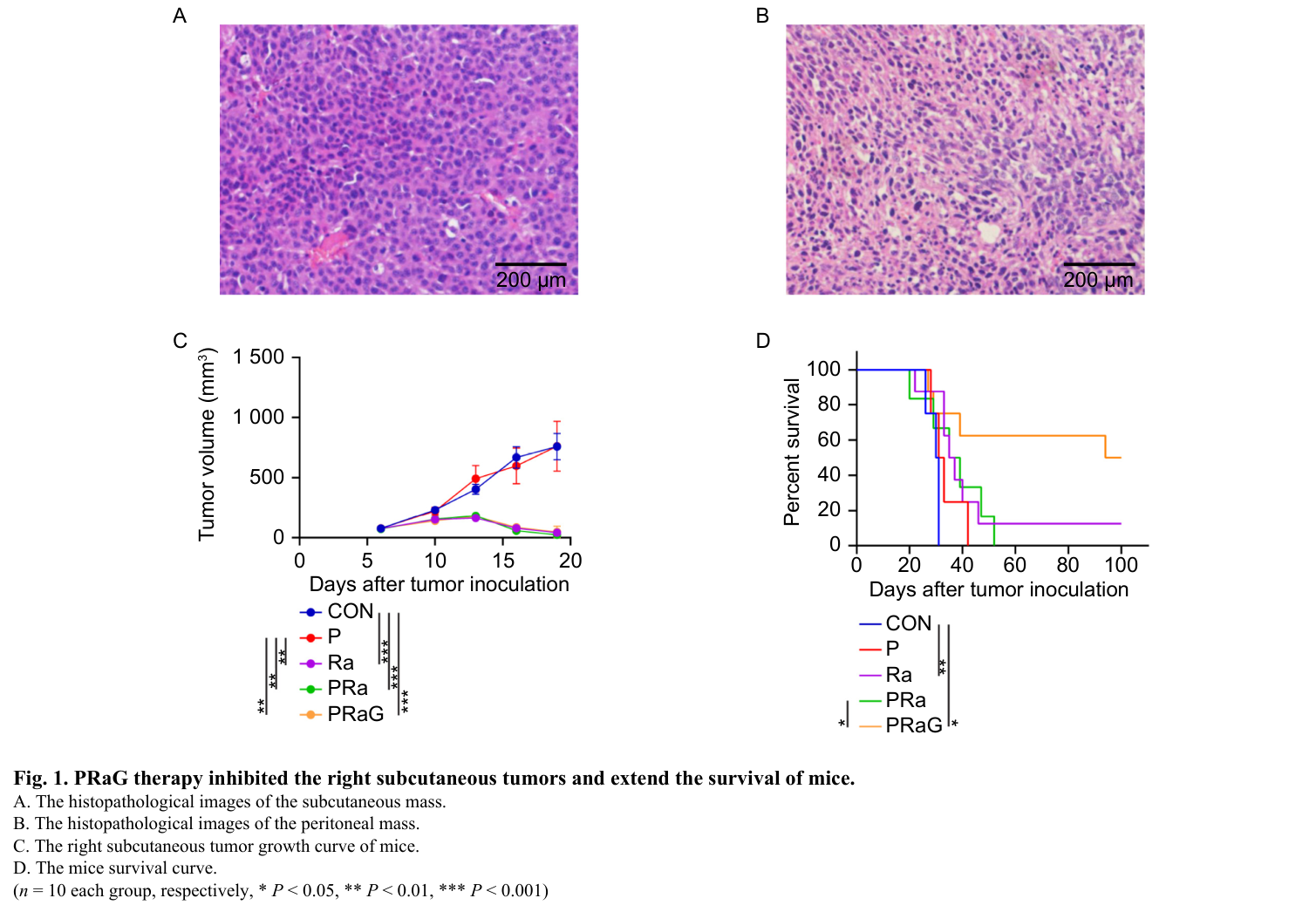
PRaG reduced tumor growth versus control and checkpoint blockade alone, and prolonged survival versus control and the radiation–checkpoint doublet. Circulating CD4+ T-cell and granulocytic suppressor-cell proportions decreased in specified comparisons.
Reading the original figures
 View full size ↗
Figure 1 compares tumor growth and mouse survival across the experimental groups. Growth curves include 10 mice per group. The survival experiment used a separate cohort (12 mice per group in the methods). This is animal evidence, not a patient survival estimate; the curves do not show that PRaG outperformed every comparator. The original caption gives n = 10 per group without separating the cohorts, so the sample-size discrepancy should be checked in the source.
Peng et al. · Diseases & Research, 2025 · Figure 1 · CC BY 4.0. Reproduced without alteration.
Safety findings
This animal experiment does not establish clinical safety.
How should we interpret it?
Mouse results cannot estimate benefit in patients. Immune-cell associations alone do not prove a causal mechanism.
Read the original source
This independently written summary was checked against the publicly available abstract. Selected figures, where included, are checked against the full publication. This is not a full-paper translation or a clinical recommendation.
The Anti-tumor Effect and Immunological Cell Changes of PRaG Therapy in Colon Cancer Peritoneal Metastasis of Mice · DOI: 10.54457/DR.202402016
Related publications from the same research program
- Impact of PRaG Therapy on Peripheral Immune Cells of Subcutaneous Tumor Peritoneal Metastasis Model of Colon Cancer
- Study of effect of PRaG therapy in colon cancer transplanted tumor mouse model
Educational reporting, not individualized medical advice. Discuss treatment decisions with your clinical team.